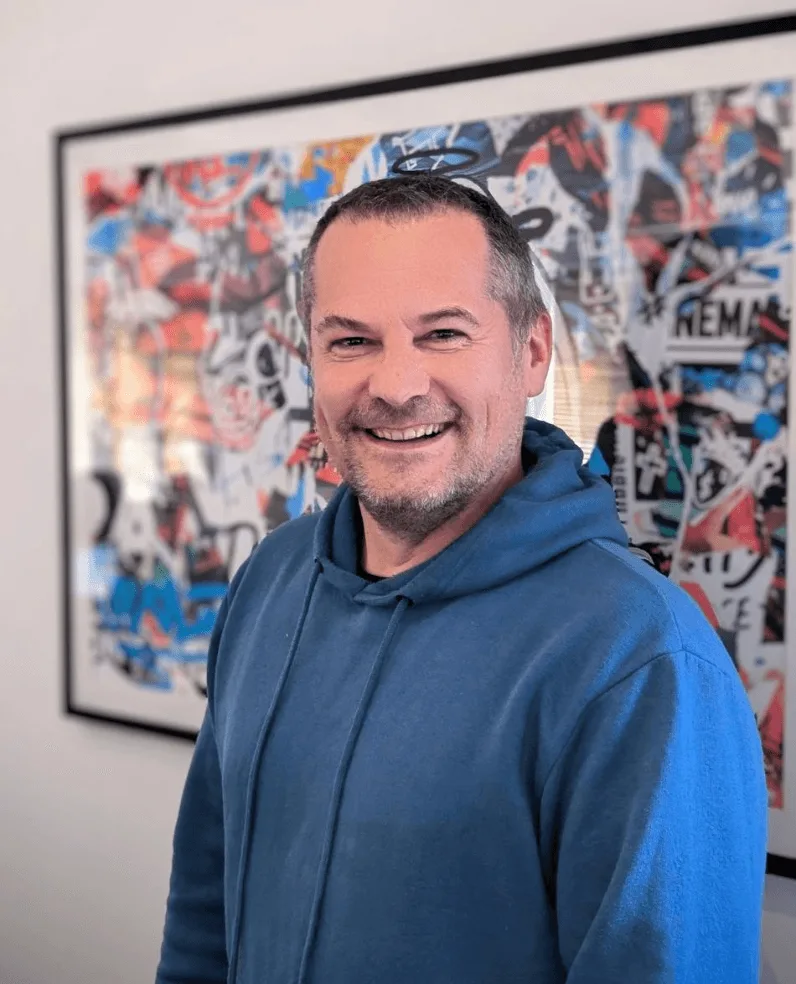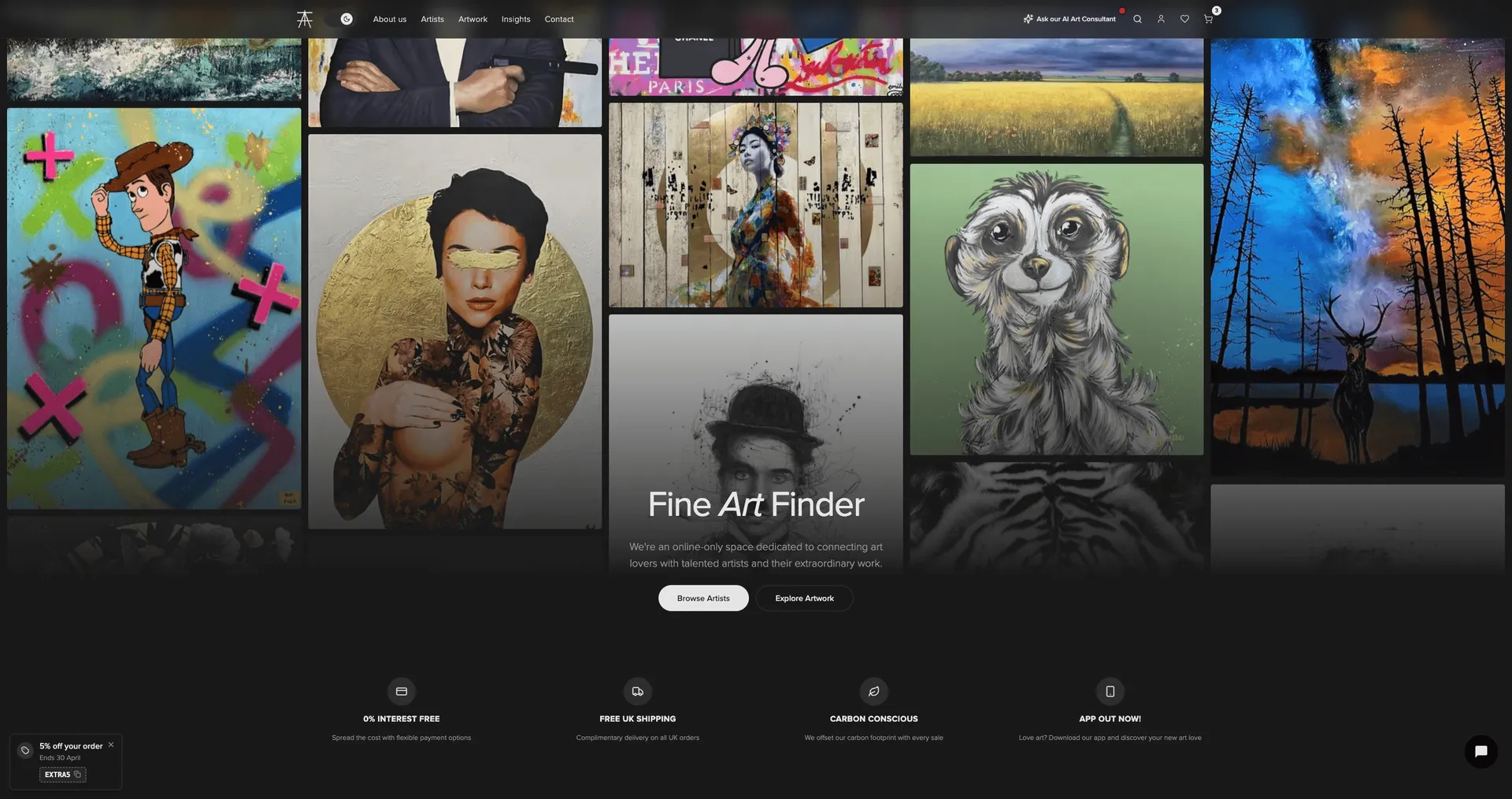
Our creative director Sam has been a web developer for over 20 years, and has been the boss of Design Monkey for pretty much all of that. Fine Art Finder is the gallery he and operations director Siobhan have built together: a family-run online gallery, with a showroom in Tadlow, Royston, full of original paintings from artists they genuinely like. They pick every piece, hang every wall, and answer the phone themselves.
It's the project where 20 years of web dev, a few strong opinions on how an art gallery's website should work, and AI used in the places it actually helps all came together at the same time.
I wrote this because it's a good example of something worth understanding. If you were wondering what an SEO-first, AI-assisted build really looks like from a team that genuinely knows what they're doing, then Fine Art Finder is pretty much as clear an example as I've got.
A small family gallery, with strong opinions
If you spend any time looking at art websites, you develop views on the matter. Sam has more than most. Most art gallery websites fall into one of two camps. One is the WooCommerce site where a painting is treated like a radiator in a plumbing catalogue. The other is the beautiful art-directed site that loads in seconds, doesn't show up anywhere on Google searches, and won't tell you the price of anything anyway. Both fail. Sam wanted a site that felt like a gallery, ranked like a real ecommerce site, and actually let you see what you were buying. That's much trickier than you'd think, and it's probably where most gallery sites fall down: by picking one side or the other and doing it less well.
An art gallery built headless, done right.
The Fine Art Finder site was built in Lovable as a fully headless website. If you've read what I've written about Lovable and Cursor recently, then you'll know my opinion of them. Used properly, they're excellent. Used improperly, they produce sites that might seem to function well at the time of launch but start losing traffic, conversions, and Google visibility right from the first month onwards.
The front end is separated from the content layer, so the site is fast, flexible, and not burdened by all the slow, creeping cruft of a WordPress theme that turns a fast site slow and a ranking site invisible.
SEO was planned for from the very start. URLs, schema, headings, internal links, the whole lot. No plugins making the decisions. If you've read what I wrote about why SEO so often fails for businesses, then that's not this at all. Doing the boring structural stuff right is still what shifts a site higher in the rankings. Fine Art Finder has a physical gallery location in Royston as well as an online presence, and that was built into the plan from day one. Google Business Profile, local schema, all the things that quietly compound for years.
Where AI actually earns its keep
We wouldn't have been able to build this to this standard 18 months ago. Any gallery that cares about its catalogue has a content problem. Every painting needs a good description. Every artist needs a compelling bio. Every blog post needs unique and researched content. Do it by hand from a blank page and you'll be talking to the paintings by the time you've finished. Don't bother and you have "Nice oil on canvas. 60x40cm." under every artwork.
So we use AI as an assistant. It does the heavy lifting in three places, and a human then does the bit that actually matters: making it sound like us.
Artwork descriptions: AI gives us a researched first pass on each piece. Sam and Siobhan then go through them, in the gallery voice, matched to the content and to the artists they know personally. Not just word filler. Proper stuff.
Artist bios: The assistant pulls together the background research and a draft. We've got Alison Johnson, Brenda Herd, John Horsewell, and Nigel Cooke on the walls, and we wouldn't want to let the greats down with skimpy bios. It's equally important for those at the start of their careers to have a proper bio too, as we find many don't, and AI helps us get there without cutting corners.
Blog: For posts like this one, the AI is set up to generate the skeleton and first pass of a draft, and then a human takes it from there. This post you're reading now, for instance, I wrote myself. Victoria handles the social side, so when we're talking to people we're actually talking to them, not just announcing new stock to the internet.
All of that runs alongside the DM SEO Tool, our own bespoke AI-powered SEO platform that handles the structural side of the site. Sam has it for free, so we guess it's a perk of running both businesses.
AI handles the slog so the humans get to do the human bit. Choosing the artists. Hanging the work. Talking to the customer. That's how a small family-run gallery competes with much bigger operations without losing the personal touch that brought people in to begin with.
Three lessons from this
AI doesn't mean you don't need to know what you're doing. It just lets you get on with the stuff you're good at. Point all of this at a website built by someone without Sam's twenty years of web experience and you end up with rubbish. The model is only as good as the person driving it, and that's a problem we keep seeing from people we've been asked to come and sort out after they've had a "DIY" go at a web project with AI and it's gone wrong.
Headless plus AI really is a step change. I still speak to clients weekly who are running on Wix and can't work out why they never come up for the queries they care about, or why they can't compete with the bigger names online. The gap between what a template-based site can achieve and what a proper 2026 site can do is growing larger by the month. If you're selling something that needs to look good online, then you need a site that looks good.
Fundamentals beat features. Fine Art Finder can be found because the foundations are in place. URLs are clean. Load times are fast. Schema is correct. Links make sense. I can say this a thousand times, but it's the thing that really does make the difference between sites that can compete in the market and sites that can't.
The Royston showroom
Our new gallery in Tadlow, is both online and open to the public. If you're in or near Royston and Cambridge, it's really worth making a special trip to see the works in person. Paintings always seem different up close, and have a different feel, than they do on a browser. Frames that look acceptable in a pixel perfect picture, in the flesh, turn out to be magnificent.
The physical gallery also gives us something a purely online operation can't: actual people, walking in, looking at actual art, having a chat with whoever's in that day, and leaving real reviews afterwards. Those local signals matter, both to Google and to the next person deciding whether to drive over.
What's next?
Fine Art Finder has been officially launched, the Tadlow showroom is trading, and we've already started planning the next round: more AI-assisted discovery for collectors, better ways of registering artists, and more editorial.
Because the gallery is part of our digital agency, we use it as a testing ground for new features, to make sure they work well before we deploy them on our client sites (not many other digital agencies do this, we find).
If this interests you, then for artists, galleries and publishers that need a better website that will get more traffic, enquiries and sales, do contact us. We're a small team with 20 years of web development behind us, and we've just used our own gallery to prove what happens when a site is designed with search, content, and a real human at the end of the phone.
Fine Art Finder is open to visitors online at fineartfinder.co.uk
You can visit us locally in Royston (Tadlow showroom). There'll normally be someone there who can show you around the works, and there's a good chance of getting a coffee too.
Fine Art Finder is a search-first ecommerce site, built to 2026 standards. A family-run gallery, technical strength, and AI used where it actually helps. If you're looking for an art gallery website that really prioritises SEO and uses AI properly, that's exactly what we'd love to build for you.
Let's talk about your website.